Narva is Estonia's third city, its Russian-speaking city, and its hardest case. 95.7% of the population has Russian as a mother tongue and just under half holds Estonian citizenship. It has the country's worst unemployment, its lowest wages, its coldest weather, and the only shrinking population of the four cities here. It also has €354 million of EU transition money pointed at it and the state's integration agency headquartered inside it.
Table of Contents
About Narva
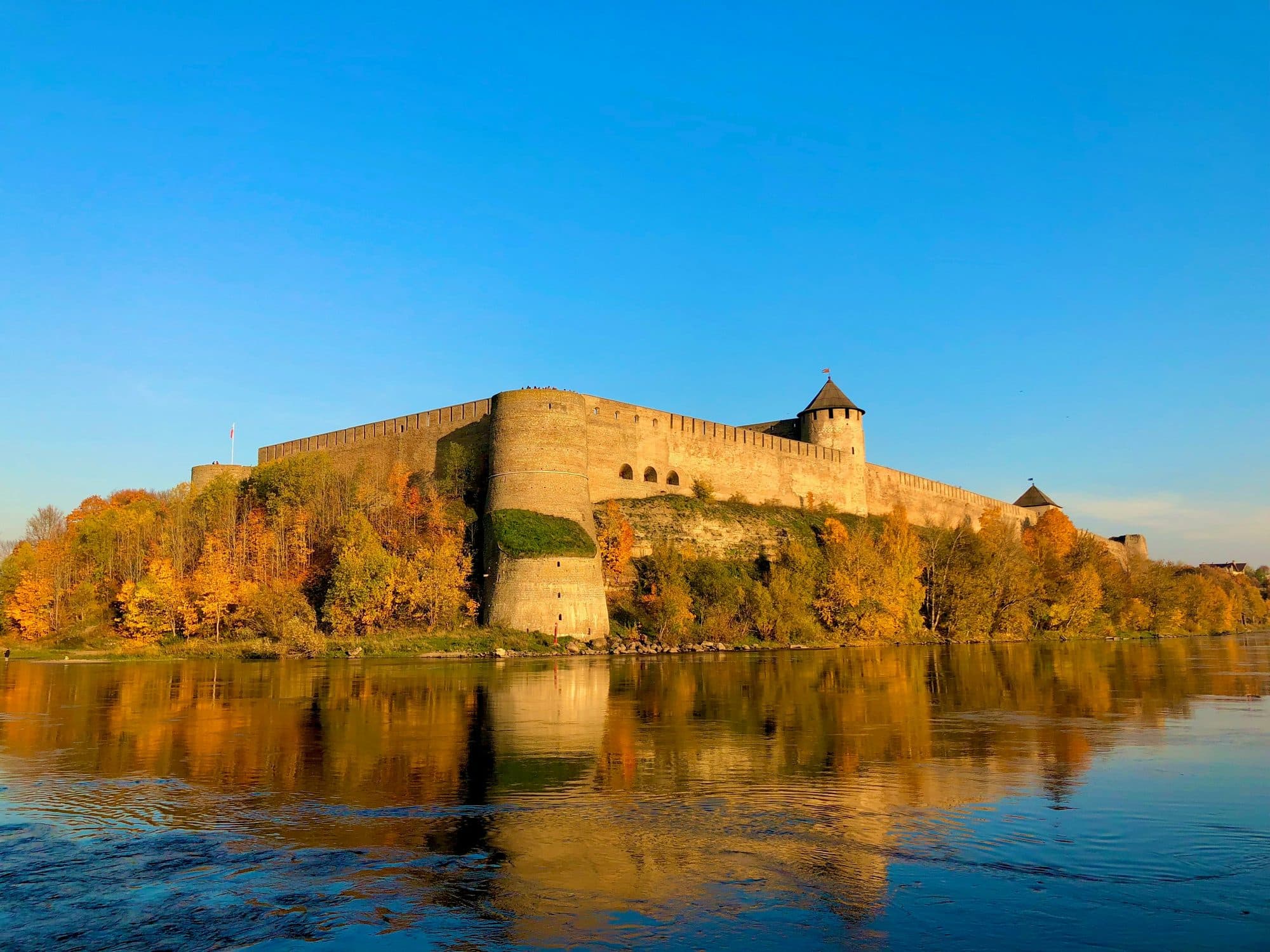
The fortress in the photograph is Ivangorod, and it stands in Russia. That view is the single most useful thing to understand about Narva: it is an Estonian city whose daily life, language and economy are shaped by what is on the other side of the river.
The citizenship figure is the one that matters. At 1 January 2024 Narva had 26,060 residents with Estonian citizenship — 49% of the city, per the city's own population register bureau. Nationally the figure is 82.2%. Just over half of Narva does not hold an Estonian passport. That single number explains more about the place than the mother-tongue census data does, and it is more current.
Narva is the only one of the four cities that has shrunk every year since 2022 — down 2,959 people, or 5.48%, over four years. Tallinn, Tartu and Pärnu all grew in 2022–23 as Ukrainians arrived. Narva did not.
Cost of Living
What is published cuts the other way.
Narva has the most expensive heating in Estonia. €137.69/MWh excluding VAT, against €62.41 in Tartu and €77.82 in Tallinn — 1.8× the Tallinn price. The Competition Authority approved it with effect from 3 May 2026 and attributes the level to gas-fired production. Water is the cheapest of the four at €2.67/m³, but on a much older tariff — January 2024. Cheap property and expensive heat is a genuinely different cost structure from the rest of the country, and it is the opposite of what people expect.
Neighbourhoods
Narva's general plan names 13 city districts: Vanalinn (the old town), Joaorg, Kreenholmi, Kalevi, Kerese, Pähklimäe, Soldino, Siivertsi, Sutthoffi, Paemurru, Kulgu, Veekulgu and Elektrijaama.
Job Market
| Ida-Viru | National | Best in Estonia | |
|---|---|---|---|
| Registered unemployment, June 2026 | 9.9% | 5.6% | 3.9% (Pärnu) |
| Labour force survey, 2025 | 12.7% (North-East) | — | 6% (South) |
| Median gross wage, Q1 2026 | €1,407 | €1,753 | €1,958 (Harju) |
| Share of national GDP, 2024 | 6% | 100% | 63% (Harju) |
9.9% registered unemployment is the highest in Estonia, nearly double the national 5.6% and almost four times Hiiu county's 2.6%. The median wage is 28% below Harju's.
What actually happened here, in two numbers. Manufacturing and utilities employment in Narva fell from 9,800 in 2004 to 2,700 in 2022 — from the Mayor's own published presentation. Public services, education and healthcare rose from 5,600 to 6,600 over the same period, which does not come close to replacing it. Employment rate: 54.7% of the working-age population in 2023, on 23,500 employed residents.
What is being done about it
The money, and who is hiring:
- €354 million from the EU Just Transition Fund, confirmed October 2022, over seven years
- €273m for economy and labour; €67m for environment and social inclusion
- An €8.46m industrial incubator due for completion by August 2026
- Largest employers: Enefit Power, Enefit Solutions, Fortaco Estonia, Aquaphor International, Hanza Mechanics
And the caveat
What has not landed yet:
- ERR has reported that Just Transition Fund disbursement in Ida-Viru is well behind schedule
- The €354 million is committed across seven years from 2022 rather than spent
- The incubator is a completion date, not a business already hiring
Getting Around
City buses are run by Go Bus, which publishes no fares for Narva. The prices below come from the city's own tourism portal, last modified February 2026, and carry no effective date — so treat them as indicative and confirm the current price when you buy.
| Ticket | Price |
|---|---|
| Single, electronic card | €0.70 |
| Single, cash from the driver | €1.00 |
| 1 day / 10 days / 20 days | €1.50 / €8.00 / €15.00 |
| 30 days | €20.00 |
| Free | Pupils (1 Sep–20 Jun), 66+, people with profound disability, Chernobyl clean-up participants |
Rail: about five direct Elron services a day to Tallinn, 3 h 15 min to 3 h 40 min. No direct service to Tartu — change at Tapa. No scheduled air service; Estonian Airports operates Tallinn, Tartu, Pärnu, Kuressaare and Kärdla, and Narva is not on the list.
The border, as at August 2026 — and it is due to change
Narva-1 is a pedestrian-only crossing operating 07:00–19:00. The sequence: closed to all vehicles from 1 February 2024 for Russian reconstruction work at Ivangorod; night closures from 1 May 2024; full customs control from 8 August 2024; hours cut from 07:00–23:00 to 07:00–19:00 on 15 June 2026, extended through 31 August 2026. Vehicles must use Koidula or Luhamaa.
Two warnings. First, a government decision is due before 31 August 2026, so this will have moved by the time you read it. Second, the Police and Border Guard Board and the state crisis portal currently contradict each other on the hours (07:00–19:00 versus 07:00–23:00) and neither page carries an update date. The Estonian government's standing advice is to avoid travelling to Russia entirely, and it warns that crossings can close at short notice and strand people on the Russian side.
Expat Life
Narva is the inverse of Tallinn. 36% of the city speaks any foreign language — the lowest figure in Estonia, against 81% in Tallinn. If you speak Russian, this is the easiest place in the country to arrive. If you speak only English, it is the hardest.
There is no city welcome centre — but the state's integration agency lives here. Narva runs nothing equivalent to Tallinn's International House or Tartu's Welcome Centre, and no city newcomer service appears to exist. Most guides stop there and conclude Narva has nothing.
They are wrong. The Integration Foundation moved its head office to Narva (Linda 2), and the Narva Estonian Language House operates from the same address — free Estonian courses, language consultations, and the national Settle in Estonia adaptation programme. Open Mon–Thu 09:00–17:00, Fri to 16:00. See the language page; the free courses fill within minutes of registration opening, and there are only two Language Houses in the country. One of them is here.
University of Tartu Narva College has 812 students. All its programmes are taught in Estonian, but three bachelor's programmes can be applied to without prior Estonian — teacher training for multilingual schools, youth work, and IT systems development among them. The college also runs Russian-language summer schools and semester programmes.
Climate & Winters
These are Jõhvi's numbers, not Narva's. The figures below come from Jõhvi, about 50 km west — the station the Estonian Weather Service itself uses to characterise Ida-Viru, and the only one in the county with 1991–2020 normals. Narva is marginally more continental, being further from the Gulf of Finland, so read them as close rather than exact.
Monthly mean temperature, Jõhvi station, 1991–2020 normals:
This is the coldest of the four: annual mean 5.5 °C against Pärnu's 6.8, and a February mean minimum of −8.5 °C. Estonia's national record low of -42.6 °C was set at Narva on 30 December 1978, and the record high of 35.4 °C at Narva-Jõesuu in August 2010 — the same corner of the country holds both ends.
Snow, from the same station: in 1962–2001, Jõhvi had lying snow on Christmas Eve in 83% of years.
Practical Information
| Detail | |
|---|---|
| Language | Russian works everywhere; Estonian is needed for the state. Free courses at the Language House here. See the language page. |
| Heating | €137.69/MWh excluding VAT — the most expensive in Estonia. Get a January bill before signing anything. |
| Schools | The transition to Estonian-language instruction runs to 2030 for basic school. Ida-Viru is where the teacher shortage bites hardest. |
| The border | Pedestrian-only, 07:00–19:00, under a decision expiring 31 August 2026. Check before you plan anything around it. |
| Getting to Tartu | No direct train. Change at Tapa. |
Related guides
Frequently Asked Questions
Is Narva really as cheap as people say?
It is the cheapest of the four cities on housing by a wide margin. The claim is repeated everywhere; what is rarely said is that the local wage and job market are correspondingly thin, so the saving is real only if your income comes from elsewhere.
Can I live in Narva speaking only Russian?
Day to day, yes — the city is overwhelmingly Russian-speaking. Dealing with the Estonian state is a different matter, and naturalisation requires Estonian regardless of where you live.
Is Narva safe?
It is an ordinary Estonian city with ordinary Estonian crime rates. The reputation it carries abroad is about geopolitics rather than daily life.
What is the job market like?
Narrow. Ida-Viru county contributes a small share of national GDP relative to its population, and the region is going through a managed transition away from oil shale.
How cold does it get?
This is the coldest corner of the country, and inland Ida-Viru holds Estonia's record low.
Can I cross into Russia from Narva?
As at August 2026 the Narva-1 crossing is pedestrian-only and open 07:00–19:00; vehicles must use Koidula or Luhamaa. The sequence: closed to all vehicles from 1 February 2024 for Russian reconstruction work at Ivangorod, night closures from May 2024, full customs control from August 2024, and hours cut on 15 June 2026 under a decision extended through 31 August 2026. Two warnings. A government decision was due before that date, so this has almost certainly moved by the time you read it. And the Police and Border Guard Board and the state crisis portal currently contradict each other on the hours, neither page carrying an update date. The Estonian government's standing advice is to avoid travelling to Russia entirely, and it warns that crossings can close at short notice and strand people on the Russian side.
What does a flat in Narva cost per square metre?
There is no official figure. The Land and Spatial Development Board's quarterly review, which does cover Tallinn, Tartu and Pärnu, does not extend to Narva, so any price per square metre quoted for the city — including the familiar claim that it is the cheapest place in Estonia to buy — comes from a listings portal or crowd-sourced data rather than from the transaction register. Ask an agent for comparable completed sales instead. What is published points the other way on running costs: Narva has the most expensive district heating in Estonia at €137.69/MWh excluding VAT, 1.8 times the Tallinn price, approved with effect from 3 May 2026 and attributed to gas-fired production.
Where do I learn Estonian in Narva?
At Linda 2. The Integration Foundation moved its head office there, and the Narva Estonian Language House operates from the same address — free Estonian courses, language consultations and the national Settle in Estonia adaptation programme, open Monday to Thursday 09:00–17:00 and Friday to 16:00. There are only two Language Houses in the whole country; the other is in Tallinn and there is none in Tartu. The constraint is places rather than money: a Ministry of Culture study found free courses fill within minutes of registration opening. Narva is also one of the four cities where Harno holds the free state proficiency exam, and one of three where the citizenship civics exam runs monthly.
Can I study in Narva without speaking Estonian?
Partly. University of Tartu Narva College has 812 students and teaches all of its programmes in Estonian — but three bachelor's programmes can be applied to without prior Estonian, among them teacher training for multilingual schools, youth work and IT systems development. The college also runs Russian-language summer schools and semester programmes.
What language will my child be taught in at a Narva school?
Estonian, on a fixed national schedule. The law adopted in December 2022 switched kindergartens and grades 1 and 4 in 2024/25 and grades 2 and 5 in 2025/26; basic school finishes in 2029/30 and upper secondary in 2032/33. A child may keep 2 lessons a week of their own language if at least 10 pupils at the school ask for it. The strain is teachers: school heads in transitioning schools and teachers of Estonian need C1, which only 29.7% of C1 candidates passed in 2025, and the National Audit Office found in 2023 that around 20% of new school staff each year did not know Estonian at the required minimum level. Ida-Viru is where that bites hardest.