About one Estonian resident in twenty-three is a citizen of no country at all. In 1992 it was closer to one in three. That fall is the single largest social change in post-Soviet Estonia, and it is still happening — but 2025 was the year the terms of it changed.
"Undetermined citizenship" — the grey passport, halli passi omanikud — means a person who settled in Estonia before 1 July 1990 and is recognised as a citizen by no state. There were about 494,000 of them in 1992, 32% of the population. At the start of 2026 the share was 4.3%, and that group voted in a local election for the last time on 19 October 2025.
The constitutional amendment of 26 March 2025 removed the local franchise in two stages. Third-country nationals lost it before the October 2025 elections; stateless residents got one last vote and lose it from 2029. There is no simplified naturalisation route — the state's answer to the franchise question is "naturalise", not "make naturalising easier".
Table of Contents
- What it is
- How many, and the trend
- What the grey passport does
- The vote, and what changed
- The routes out
- The three statuses, compared
- The file, and the document you do not need
- What leaving costs, and who charges it
- How long the way out takes
- Refusal, and challenging it
- Where the language bar lands
- The newborn bill
- FAQ
What "undetermined citizenship" actually means
The EMN Estonia definition, which is the cleanest published one: "Määratlemata kodakondsusega isikud (nn halli passi omanikud) on isikud, kes on asunud Eestisse elama enne 01.07.1990 ja elavad jätkuvalt Eestis" — persons who settled in Estonia before 1 July 1990 and still live here.
The status exists because of how the 1992 restoration worked. Estonia recognised the pre-1940 citizenry and its descendants as citizens by continuity — see citizenship by descent — which left everyone who arrived during the Soviet period outside the citizenry. Most were Soviet citizens whose state had dissolved. Some took Russian citizenship, some naturalised, and a large group did neither and became citizens of nowhere.
It is not the same as being a Russian citizen in Estonia, and the difference cuts both ways. At 1 January 2026, 5.5% of residents held Russian citizenship and 4.3% undetermined, against 82.2% Estonian, 4.6% Ukrainian and 3.4% other. These are different groups with different rights, and they have just been treated differently by law: Russian and Belarusian citizens lost the local vote before the October 2025 elections, while stateless residents were allowed one more. Conversely, a stateless applicant for citizenship has one advantage a Russian citizen does not — see the routes out below.
How many, and the trend
| Date | Count | Source |
|---|---|---|
| ~1992 | 494,000 — 32% | EMN, Rändepoliitika aastaraport 2025 |
| 2004 | 127,318 | EMN — holders of a long-term residence permit |
| 1 Jul 2010 | 99,173 | Population Register, via ERR |
| 1 Jul 2020 | 69,993 — about 6% | Population Register, via ERR |
| 1 Aug 2023 | 62,888 — about 4.7% | Siseministeerium |
| 1 Jun 2025 | 59,482 | Interior Ministry data |
| 2025 | 59,203 | EMN — long-term permit holders, plus 2,791 on temporary permits |
From roughly one Estonian resident in three in 1992 to fewer than one in twenty in 2026 — a fall of about 435,000 people in 34 years, and still falling by roughly 1,500 to 2,000 a year.
65% of stateless residents want Estonian citizenship and are willing to work for it — an Institute of Baltic Studies survey for the Ministry of Culture and the Integration Foundation, fieldwork October to December 2024, 1,991 respondents plus seven focus groups, published February 2025 — the Integration Foundation's own library dates the entry 26 February. About 15% plan to apply within a year and 40–45% within five. The single biggest stated obstacle is the B1 language requirement.
What the grey passport does, and what it does not
This is the document the shorthand refers to. It is a travel document issued by Estonia to a person Estonia does not count as its citizen — which is the whole of the situation, printed on a cover.
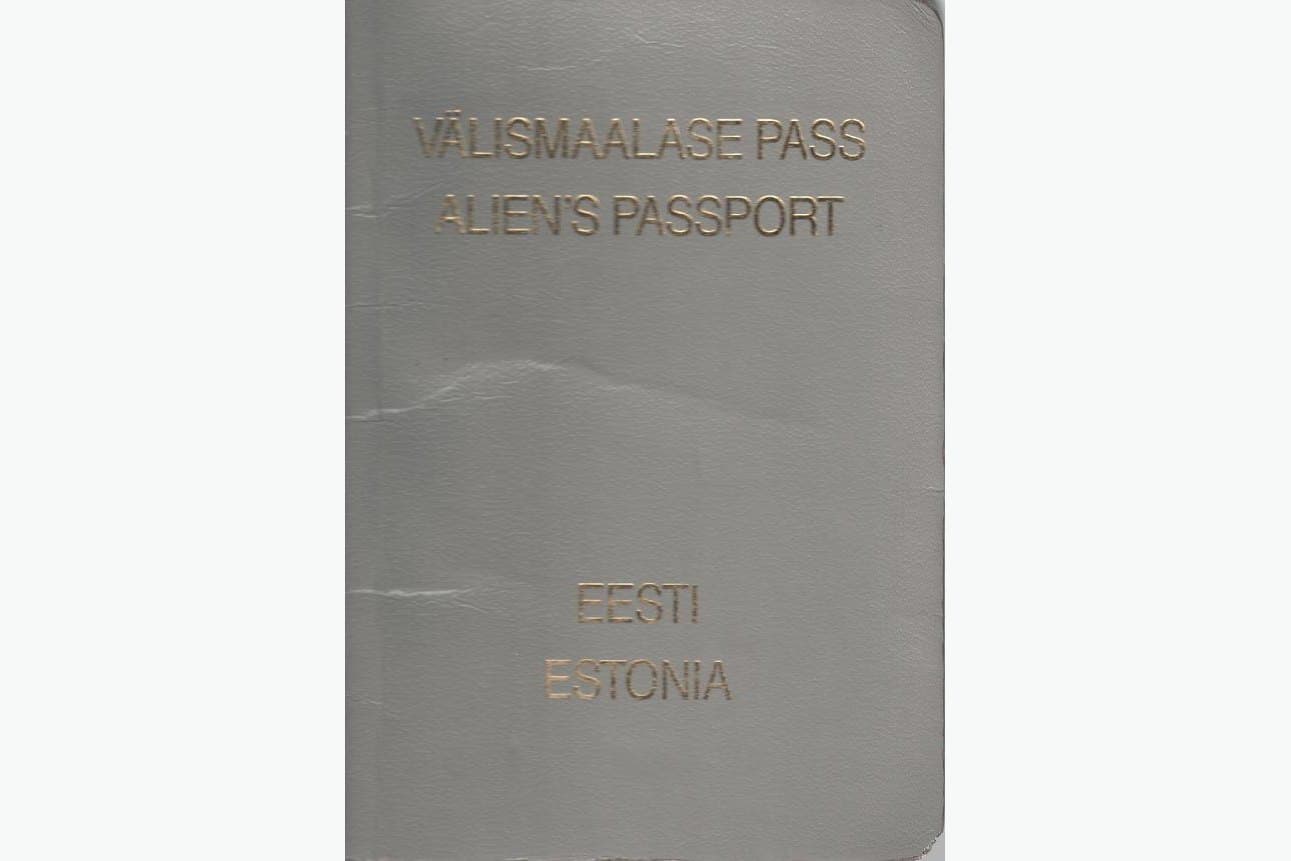
The alien's passport is, in the Police and Border Guard Board's own words, "a travel document issued by the Republic of Estonia to certain foreigners". It goes to a foreigner who holds a valid Estonian residence permit or right of residence and who can show they hold no travel document from their home state and cannot obtain one. Fingerprints from age 12; validity up to 10 years.
| Category | At a service office | Self-service portal |
|---|---|---|
| 18 and over | €60 | €50 |
| Under 18 | €25 | €20 |
| Retirement age reached | €25 | €20 |
| Moderate to profound disability | €25 | €20 |
| Expedited | €250 | — |
What it permits, in Estonia and in Europe:
- Work, healthcare, property ownership, marriage, registering children's births, social benefits
- Movement in the Schengen area as a residence-permit holder, 90 days in any 180
- Visa-free entry to Russia, under a Russian decree — unusual and genuinely useful to holders
- Belarus is also commonly listed as visa-free
What it does not, and this list is longer:
- It is not proof of citizenship
- No vote in Riigikogu or European Parliament elections — and, from 2029, none in local elections either
- No service in the defence forces, police, security services, prosecution, courts or ministries
- No EU free movement. Working in another EU state needs a permit
- Some states refuse the document outright — Lebanon, Madagascar, Morocco, the UAE, Peru, Chile and South Africa have been named
The vote, and what changed in 2025
This is the biggest citizenship-adjacent story in Estonia, and it is the thing other guides are most likely to have wrong — usually in one of two opposite directions.
| When | What happened |
|---|---|
| 26 March 2025 | The Riigikogu passed a constitutional amendment to § 156(2) by 93 votes to 7, against a two-thirds threshold of 68 |
| 8 April 2025 | President Karis proclaimed it |
| Three months later | Stage one: the local franchise is limited to Estonian citizens and stateless persons resident in the municipality, aged 16+. Third-country nationals are out |
| 19 October 2025 | Local elections. Persons of undetermined citizenship voted for the last time |
| 1 March 2026 | Stage two: Estonian citizens only |
| EU citizens | Keep the right throughout. The amendment does not touch them |
The two ways this gets reported wrongly
"Grey passport holders can vote in local elections." Was true, is now false. They voted on 19 October 2025 and will not vote in 2029.
"Everyone lost the vote in March 2025." Also false. The amendment is deliberately two-stage: third-country nationals — overwhelmingly Russian and Belarusian citizens — were out before October 2025, and stateless residents got one more election. The State Electoral Office's guidance of 15 October 2025 confirms who was eligible, and adds a detail most coverage missed: stateless residents on a temporary permit could not vote, only those with a long-term permit or the right of permanent residence.
Scale. The Riigikogu's own focus page puts the number losing eligibility at approximately 72,000 — third-country nationals and stateless residents combined. For a baseline, the 2021 local elections had 62,585 registered voters of undetermined citizenship (24,801 voted, 39.6% turnout), 70,446 Russian citizens (29,959 voted, 42.5%) and 1,067 Belarusian citizens.
The stated rationale points straight at naturalisation. The proposal's authors explained the delay for stateless persons in terms: it "gives stateless individuals sufficient time to apply for Estonian citizenship if they wish to participate in the following local elections as Estonian citizens." That is the state saying the franchise question has one answer, and the answer is naturalise. Which makes the next section the operative one — and makes it worth noting that nothing in 2025 or 2026 made naturalising any easier.
The routes out
| Route | Who it is for | The catch |
|---|---|---|
| Ordinary naturalisation | Adults | There is no simplified adult route. Same 8 years, same B1, same Constitution exam, same €150 |
| Born in Estonia since 2016 | Children under 15 | Automatic from the moment of birth, if the stateless parents have lawfully resided here 5 years |
| Minors generally | Children under 15 | A parent who naturalised after the birth, a sole parent, an Estonian-citizen guardian, or parents applying together with the child |
| Age 65+ | Older applicants | Exempt from the writing test at the B1 exam only. Not exempt from the Constitution exam |
| Special merit, § 10 | Exceptional achievement | The Government may waive § 6 clauses 2–4 for no more than 10 people a year |
The one advantage a grey passport has over a Russian one. § 12(2) requires a naturalisation applicant to prove release from their previous citizenship — but it does not apply to a person declared stateless, because there is no citizenship to be released from. The Integration Foundation's six-step process has a step four, "have yourself released from the citizenship of another country", and for a stateless applicant that step simply does not exist. Everything else is identical.
Children born in Estonia have been covered since 1 January 2016. Citizenship Act § 13(4) grants citizenship "as of the moment of his or her birth" to a minor under 15 born in Estonia, or taking up residence here immediately after birth, whose stateless parents or sole parent had lawfully resided in Estonia for at least five years by the time of the birth. The effect is visible in the data: at 1 July 2010 there were 1,914 under-15s of undetermined citizenship; at 1 July 2020 there were 133 people under 18 in the entire country.
Undetermined, Russian Citizen, Estonian Citizen
Three statuses, held by neighbours in the same building, and they diverged sharply in 2025. Most English-language coverage collapses the first two into "Russian speakers", which is how the differences get lost.
| Undetermined citizenship | Russian citizen resident here | Estonian citizen | |
|---|---|---|---|
| Share of the population, 1 Jan 2026 | 4.3% | 5.5% | 82.2% |
| Local vote | Voted 19 October 2025 for the last time | Out before those elections | Yes |
| Riigikogu and European Parliament | Never | Never | Yes |
| Release from a previous citizenship, to naturalise | Nothing to release — § 12(2) has nothing to bite on | Must prove release from Russian citizenship | — |
| Travel document | Alien’s passport, valid up to 10 years | A Russian passport | An Estonian passport |
| EU free movement | None | None | Yes |
| Public service | Closed | Closed | Open |
| The route to the third column | 8 years, B1, two exams, €150 | The same, plus a release | — |
The 2021 baseline says how large the franchise actually was. There were 62,585 registered voters of undetermined citizenship at those local elections, of whom 24,801 voted — a turnout of 39.6%. Russian citizens numbered 70,446 registered, 29,959 voting, 42.5%; Belarusian citizens, 1,067. Two groups of comparable size, voting at comparable rates, removed from the roll in two different years by the same amendment, which the Riigikogu's own focus page scores at roughly 72,000 people losing eligibility in total.
The asymmetry that matters most is the fourth row, and it runs the opposite way to the popular intuition. The stateless applicant has the easier file, because § 12(2)'s requirement to prove release from a previous citizenship has nothing to attach to. A Russian citizen naturalising has to obtain a release from a state whose timetable and fees Estonia neither controls nor publishes. Everything else — the 8 years, the B1 exam, the 24 Constitution questions, the €150 — is identical.
The File, and the Document You Do Not Need
The Integration Foundation publishes the process in six steps, and step four is "have yourself released from the citizenship of another country". For a person declared stateless that step does not exist. Here is what remains.
Four conditions, of which the first two are the ones that end the route when the answer is no.
- Do you already hold a long-term residence permit? Almost certainly yes, and it matters more than it sounds. EMN counted 59,203 people of undetermined citizenship holding a long-term residence permit for 2025, against 2,791 on temporary permits. Long-term resident status is the rung the Citizenship Act demands you already stand on — and for this group it is usually the rung already held.
- Do you hold the B1 certificate, or an exemption from it? The binding condition, and the one the state has measured: 65% of stateless residents say they want citizenship, and the language requirement is the obstacle they name. Education acquired in Estonian waives this exam under § 8(5) — and waives nothing else.
- Is your address registered in the Population Register? § 6 clause 2³ names it in the statute, and the State Electoral Office's 2025 guidance turned on the same distinction: stateless residents on a temporary permit could not vote, only those with a long-term permit or the right of permanent residence.
- Do you hold the Constitution exam certificate? 24 multiple-choice questions in Estonian, 45 minutes, 18 correct to pass, with the Constitution and the Citizenship Act in Estonian and a dictionary permitted in the room. Registration closes 15 days before a sitting; the result is immediate.
If the answer to the first two is yes, you are further along than the population statistics suggest. The single largest group of new Estonian citizens in 2025 was people of undetermined citizenship — 318 of 781 — and those two hard conditions are the ones that separate them from the 59,203 who did not apply.
The alien's passport has its own conditions, and one of them is circular. The Board issues it to a foreigner who holds a valid Estonian residence permit or right of residence and who can show they hold no travel document from their home state and cannot obtain one. Fingerprints are taken from age 12, and the document is valid for up to 10 years. That second condition is what keeps the document tied to the status: it is issued precisely because no other state will issue one, which is also the reason several states — Lebanon, Madagascar, Morocco, the UAE, Peru, Chile and South Africa have been named — decline to accept it at their own borders.
What Leaving the Status Costs, and Who Charges It
Naturalising is cheap in state fees and expensive in everything the state does not price. Staying is the opposite: nothing to apply for, and a document to re-buy every decade.
| What it costs | Who charges it | |
|---|---|---|
| The citizenship application | €150 | PPA state fee |
| Both exams | Free | Harno |
| Language courses | Free — if you get one of the places | Integration Foundation, Settle in Estonia |
| Release from a previous citizenship | Not applicable to a stateless applicant | — |
| Staying: the alien’s passport | €60 at a service office, €50 self-service, every 10 years | PPA state fee |
| …reduced rate | €25, or €20 self-service, under 18, at retirement age, or with a moderate to profound disability | PPA state fee |
| …expedited | €250 | PPA state fee |
| Private tuition, if the free places run out | Not published — ask the school | A private school |
The unpriced cost lands hardest where the population is. The free courses are rationed and the private ones are not priced by anyone — so the fallback is out-of-pocket tuition, in the county least able to pay for it. Ida-Viru's median gross wage is €1,407 against €1,958 in Harju, and registered unemployment there is 9.9% against 5.6% nationally. A course that is a rounding error in Tallinn is a real decision in Narva, and that is before anyone counts the travel to a sitting.
The long-term resident status the Citizenship Act requires you to already hold costs €185, or €93 for a child under 15 or a pensioner. For this population it is almost always already held and already paid for.
How Long the Way Out Takes
The residence condition is, for this group, usually satisfied decades over. What is left is an exam calendar and an unpublished decision, and only one of those can be planned around.
The residence, and usually the long-term permit as well
EMN counted 59,203 people of undetermined citizenship on long-term residence permits for 2025 and 2,791 on temporary ones. The 8-year condition is not what is stopping this population.
The B1 exam, free, results in 40 days
59.57% of those who sat it passed in 2025, down from 62.93% in 2024 on rising registrations. Below 45% of the points there is no re-registration for 6 months.
The Constitution exam, result immediate
Tallinn, Tartu and Narva monthly; Pärnu, Valga and Rakvere twice a year and only if at least five people register. One booking may be held at a time, so the two exams queue rather than overlap.
PPA transmits the file to the Government
Its own wording. This is time to the Cabinet table, not time to a decision.
The Government of the Republic decides
998 applications in 2025 produced 781 grants, of which 318 went to people of undetermined citizenship — the largest single group. No total elapsed time is published by anyone.
The state named its own deadline, and it is 2029. The authors of the franchise amendment said the delay was there to give stateless residents time to naturalise before the next local elections. Working backwards from those elections through an unpublished Cabinet stage, PPA's six months, two exams on two calendars and a realistic second attempt at B1, the language work has to start years rather than months ahead.
Refusal, and What Is Published About Challenging It
Refusals are rare in absolute terms and concentrated on exactly this group, which is a fact worth having before you file rather than after.
The grounds people expect are the conduct-and-honesty limb of Citizenship Act § 21:
- Concealed facts, or gave false information, that would preclude the grant
- Does not observe the constitutional order and the laws of Estonia
- Has acted against the Estonian state and its national security
- An unspent sentence of more than a year's imprisonment, or repeat intentional convictions
The grounds that reach this population specifically attach to a career, and sometimes not your own:
- Employment, past or present, by a foreign intelligence or security service
- Service as a commissioned member of another state's armed forces, assignment to its reserve, or retirement from it
- The spouse who entered Estonia because that person was seconded here
- Together these catch families of former Soviet and Russian officers, and are rarely stated in English
No route or deadline is published for challenging a refusal of Estonian citizenship. The decision is the Government’s rather than PPA’s: the 10-day written challenge belongs to residence permit decisions and the appeal route belongs to visa decisions, both taken by other bodies, and neither applies to a citizenship refusal. If a refusal arrives, ask in writing what the route is, and do it the same week.
Where the language bar actually lands
The section above ends where the state's answer ends: naturalise, and the binding condition is Estonian at B1. That answer is not distributed evenly across the country, and the place it is hardest to satisfy is the place with the most people who need to satisfy it.
| Narva and Ida-Viru | National | |
|---|---|---|
| Estonian citizens | 26,060 people — 49% of Narva, at 1 January 2024 | 82.2% |
| Russian as a mother tongue, census 2021 | 95.7% in Narva, 83.2% across Ida-Viru | 29% |
| Any foreign language | 36% | 76% |
| Median gross wage | €1,407 | €1,958 in Harju |
| Registered unemployment | 9.9% | 5.6% |
Narva is the inverse of Tallinn on every measure that matters to a naturalisation timetable. Just under half the city holds Estonian citizenship, against 82.2% nationally — a gap of more than thirty points. It is a low-wage, high-unemployment county, so the private course a candidate might otherwise buy is a larger share of income there than anywhere else in Estonia. And 36% of the city speaks any foreign language at all, so B1 Estonian is not a second language reached from a third; for most people it is the first one they have ever had to learn.
The free courses are real, they are in the right place, and there are not enough of them. The Integration Foundation runs Estonian Language Houses in Tallinn and Narva, plus online — which is the right geography for this population, and there is no Language House in Tartu at all. The courses are free and run A1 (100 h), A2 (150 h), B1.1 (120 h) and B1.2 (130 h). Citizenship applicants are one of the named groups they are for.
The constraint is places. In the 2025 cycle registration opened on 23 January at 10:00 for 1,200 regular and 340 specialised places across the whole year, and a Ministry of Culture study records that free courses fill within minutes of opening — and that finishing one level gives you no claim on a place at the next. Someone starting at A1 needs four separate scrambles to reach the level the Citizenship Act asks for. See the Estonian language page.
The exams themselves are better distributed than the courses: Harno holds the proficiency exam in Tallinn, Tartu, Narva and Jõhvi, adding Pärnu only if at least twelve people register, and the Constitution exam runs monthly except July in Tallinn, Tartu and Narva. Getting to an exam is not the problem. Getting to the level is.
The bill to end it for newborns — and it is still a bill
Expect other sites to report this as done law. It is not.
On 28 May 2026 the Government approved and sent to the Riigikogu a bill amending the Citizenship Act. Today a child born in Estonia can still end up of undetermined citizenship where only one stateless parent meets the five-year test. The bill would grant citizenship where "vähemalt üks tema vanematest on elanud Eestis elamisloa alusel vähemalt viis aastat ja teine vanem elab samuti Eestis seaduslikul alusel" — one parent with five years on a residence permit, the other lawfully resident.
Scale: "Aastas puudutab see kuni kümme last" — up to ten children a year. Planned entry into force 1 January 2027, and the Interior Minister, Igor Taro, framed it as drawing a line under the era of grey passports. Status as at 20 August 2026: bill 932 SE, still at first reading, last action 9 June 2026. It has not been adopted, so 1 January 2027 is a proposed date rather than one to plan around.
The same bill reportedly also ends paper citizenship certificates, gives family members of EU citizens five-year residence permits, and cuts the residence card fee. None of it is law yet.
What did not change in 2025 or 2026. No change to the 8-year residence rule, the 5-year permanent-basis rule, the B1 language level, the 24-question Constitution exam, or the dual-citizenship rules. Nothing loosened naturalisation for persons of undetermined citizenship. The state removed a right and pointed at a door it did not widen.
Immigration cases go wrong in expensive, slow ways. Get matched with an English-speaking immigration specialist in Estonia.
FAQ
What is a grey passport in Estonia?
The alien's passport — an Estonian travel document issued to a foreigner who holds a valid Estonian residence permit or right of residence and who has no travel document from any other state and cannot obtain one. Its holders are described as persons of undetermined citizenship: EMN defines them as people who settled in Estonia before 1 July 1990 and still live here. It is valid for up to 10 years and costs €60 at a service office or €50 through self-service.
How many stateless people are there in Estonia?
4.3% of the population at 1 January 2026, per Statistics Estonia. In absolute numbers, the nearest published counts are 59,482 at 1 June 2025 from the Interior Ministry and 59203 for 2025 from EMN, among long-term residence permit holders, with a further 2791 on temporary permits. In 1992 it was about 494000 people, or 32% of the population.
Can grey passport holders vote in Estonia?
Not any more, and the timing is specific. A constitutional amendment passed on 26 March 2025 and proclaimed on 8 April 2025 restricted the local franchise in two stages: third-country nationals lost it before the 19 October 2025 local elections, and stateless residents voted in those elections for the last time. From 1 March 2026 the local franchise is limited to Estonian citizens, with EU citizens keeping their right throughout. Holders of an alien's passport have never been able to vote in Riigikogu or European Parliament elections.
Is there an easier route to citizenship for stateless residents?
No. There is no simplified adult route: the same 8 years of residence, the same B1 language exam, the same Constitution exam and the same €150 fee. The single relief is that § 12(2)'s requirement to prove release from a previous citizenship does not apply, because there is none — which is a real advantage over an applicant holding a Russian passport. Children born in Estonia have had automatic citizenship from birth since 1 January 2016 where their stateless parents had five years of lawful residence.
Can someone with an alien's passport travel to Russia without a visa?
Reportedly yes, under a Russian presidential decree — the original dates to 2008 and a revised decree signed on 5 April 2017 extended it to non-citizens born after 6 February 1992 who had reached adulthood. The report is Latvian public broadcasting's, not an Estonian or Russian state announcement, and neither state publishes confirmation that the decree is still operative in 2026 — so check at a Russian consulate before booking anything. Within Europe the passport allows Schengen movement as a residence-permit holder, 90 days in any 180, and several states — Lebanon, Madagascar, Morocco, the UAE, Peru, Chile and South Africa have been named — do not accept the document at all.
Will children born in Estonia still get grey passports?
Under current law a child can still end up of undetermined citizenship where only one stateless parent meets the five-year residence test. A bill to close that gap was approved by the Government on 28 May 2026 and would grant citizenship where one parent has five years on a residence permit and the other is lawfully resident, affecting up to ten children a year, with planned entry into force on 1 January 2027. As at 20 August 2026 that bill — 932 SE — was still at first reading, last acted on 9 June 2026. It is not law, and any source presenting it as law is ahead of the Riigikogu.
What can an Estonian citizen do that a grey passport holder cannot?
The document is not proof of citizenship, and everything else follows from that. Its holders have never voted in Riigikogu or European Parliament elections, and from 2029 they will not vote in local ones either. The defence forces, the police, the security services, the prosecution, the courts and the ministries are closed to them. And there is no EU free movement: working in another member state means applying for a permit there like any third-country national, where an Estonian citizen needs nothing at all. What the status does allow is ordinary civil life inside Estonia — work, healthcare, owning property, marrying, registering a child's birth, social benefits — which is a large part of why it has persisted for three decades rather than resolving itself.
Where can I learn Estonian for free, and how hard is it to get a place?
The Integration Foundation runs free courses through its Estonian Language Houses in Tallinn and Narva, plus online, and citizenship applicants are one of the named groups they exist for. The levels run A1 at 100 hours, A2 at 150, B1.1 at 120 and B1.2 at 130. The constraint is places rather than money. In the 2025 cycle registration opened at 10:00 on 23 January for 1,200 regular and 340 specialised places across the whole year, a Ministry of Culture study records that the free courses fill within minutes of opening, and finishing one level gives you no claim on a place at the next — so someone starting at A1 needs four separate scrambles to reach the level the Citizenship Act asks for. There is no Language House in Tartu at all.
Why is naturalising harder in Narva than in Tallinn?
Because the place with the most people who need to reach B1 is the place where reaching it is hardest. Just under half of Narva holds Estonian citizenship — 26,060 people, 49%, at 1 January 2024 — against 82.2% nationally. On the 2021 census 95.7% of Narva has Russian as a mother tongue, and 83.2% across Ida-Viru. Only 36% of the city speaks any foreign language at all, against 76% nationally, so for most people Estonian at B1 is not a second language reached from a third — it is the first one they have ever had to learn. It is also a low-wage, high-unemployment county: a median gross wage of €1,407 against €1,958 in Harju, and registered unemployment of 9.9% against 5.6% nationally, so a private course is a larger share of income there than anywhere else. Getting to an exam is not the problem — the proficiency exam runs in Tallinn, Tartu, Narva and Jõhvi, and the Constitution exam monthly except July in Tallinn, Tartu and Narva. Getting to the level is.
How many people of undetermined citizenship actually naturalise in a year?
Far fewer than the 65% who say they want citizenship would suggest. 781 people were granted Estonian citizenship in the whole of 2025, by every route combined, against 998 applications — and persons of undetermined citizenship were the largest single group among them, at 318. Refusals fall disproportionately on the same group: 36 refusals in 2024, of which 35 were applicants of undetermined citizenship, and 13 in the first quarter of 2025, of which 11. Hold that against the 59,203 long-term permit holders of undetermined citizenship EMN counted for 2025, and you have the scale of the state's own answer to the franchise question.
Five things are commonly got wrong about this status, and most of them turn on the two-stage shape of the 2025 amendment. Saying grey passport holders can vote locally was true until 19 October 2025 and is false from 2029; saying everyone lost the vote in March 2025 is wrong the other way, because third-country nationals did while stateless residents got one more election and EU citizens keep the right entirely.
Another is confusing stateless residents with Russian citizens, which conflates 4.3% of the population with 5.5% — two groups with different rights, treated differently by the 2025 amendment.
The last two are about what has not happened yet. The newborn bill, 932 SE, was still at first reading on 9 June 2026, so the 1 January 2027 date is a plan rather than a fact. And there is no easier naturalisation route to wait for: none exists for adults, and the one relief a stateless applicant has is not needing a release from a citizenship they do not hold.
Related guides
The state's answer is naturalisation
No simplified route is coming, and the local franchise is going. A stateless applicant is spared only the release from another citizenship — the years, the two exams and the language bar are the ordinary route.