Estonian is not optional in the way people arriving on a work permit assume. Nobody will stop you living in Tallinn without it. But B1 is the price of a long-term residence permit and of citizenship, the exam is free and quarterly, and the pass rates at the higher levels are worse than almost anyone expects.
The Education and Youth Board (Harno) runs the proficiency exam at A2, B1, B2 and C1, free of charge, four times a year. You need 60% of the total points and a non-zero score in every one of the four sub-skills, and 59.57% of B1 candidates manage it.
B1 is the level for a long-term resident's residence permit and for naturalisation. Both also have other conditions — five and eight years of residence respectively — and citizenship adds a separate civics exam.
The exam
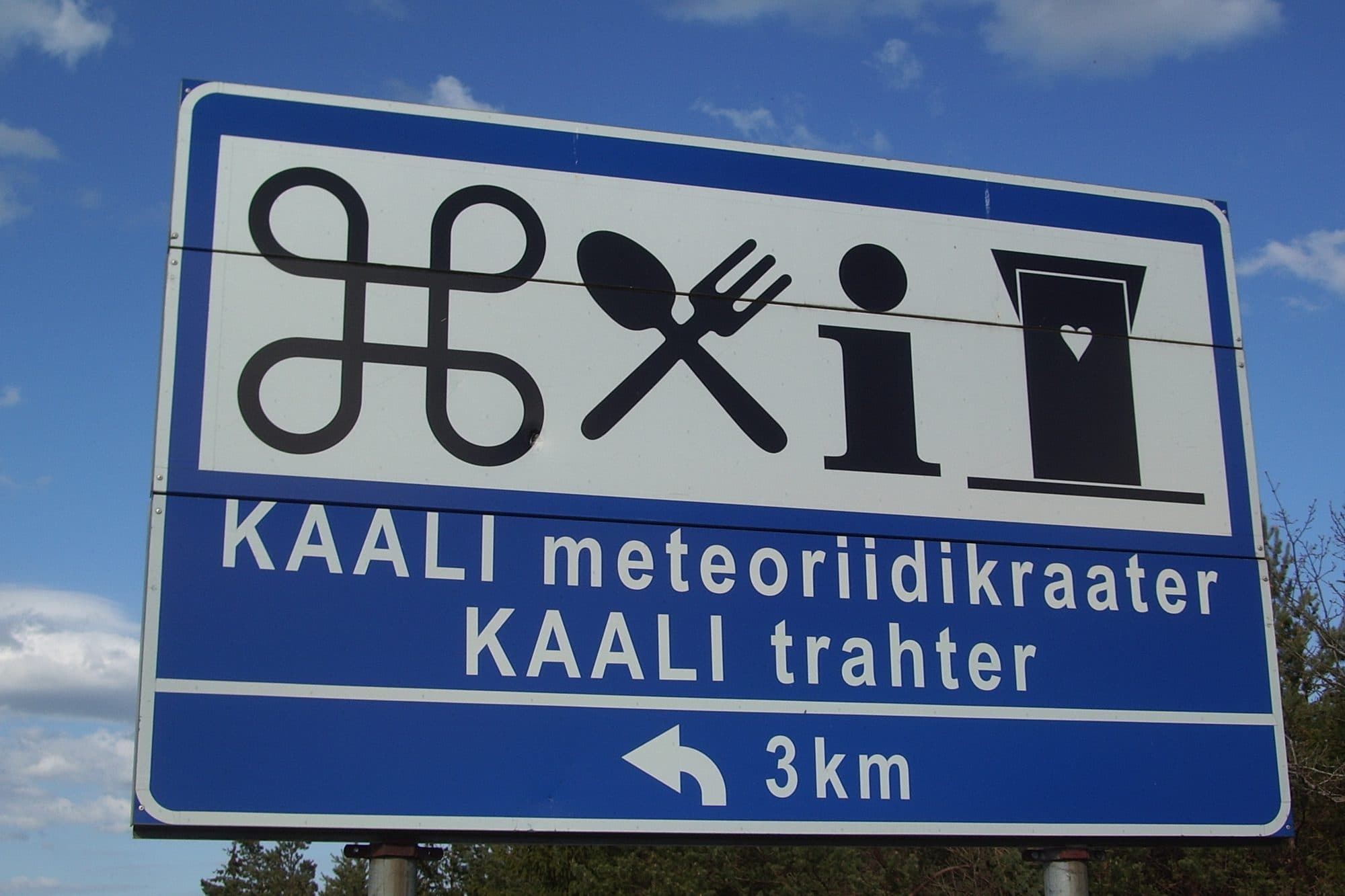
Estonian is the only language on most signs outside the cities. Reading one is a lower bar than the exam, and a more immediate one.
Harno holds the tasemeeksam once a quarter in Tallinn, Tartu, Narva and Jõhvi. Pärnu is added only if at least twelve people register for it. You register electronically in Harno's exam system, EIS, with an Estonian personal ID code; without an isikukood you apply on paper.
Register in EIS by the 1st of the preceding month
Registration closes on the first day of the month before the exam — not the week before it. Missing it costs you a full quarter.Sit the four parts
Listening, reading, writing and speaking. Different levels sit on different days within the exam window.Wait up to 40 days
Results arrive by post or email. Harno does not give results by phone. A pass produces an electronic certificate.Appeal within 30 days if you must
The appeals committee re-checks the scoring arithmetic. It does not re-mark your answers or discuss their content.
The retake rule is about 45%, not about failing
Fail with 45% or more and you can register for the next quarter immediately. Score below 45%, or fail to turn up without a valid reason, and you are barred for 6 months. Cancelling your registration at least 4 working days ahead avoids the bar entirely — so if you know you are not ready, withdraw rather than sit it and hope.
What the pass rates actually look like
Harno publishes them. The gap between B1 and C1 is the single most useful number on this page, because people routinely plan around C1 as though it were one more step above B1.
These are 2025, Harno's most recent full year. The "sat" column matters: Harno computes the pass rate against the people who turned up, not the people who registered, and several hundred register without sitting at every level.
| Level | Sat (2025) | Passed | Pass rate | vs 2024 |
|---|---|---|---|---|
| A2 | 2,736 | 1,885 | 68.9% | 70.71% |
| B1 | 3,824 | 2,278 | 59.57% | 62.93% |
| B2 | 2,176 | 808 | 37.13% | 37.87% |
| C1 | 1,950 | 579 | 29.7% | 28.36% |
Under a third of C1 candidates pass. C1 is what a doctor, a teacher of Estonian, or a school head in a transitioning school needs — which is the mechanism behind the teacher shortage further down this page.
Three of the four levels got harder to pass between 2024 and 2025, and B1 — the level that gates permanent residence and citizenship — fell furthest, from 62.93% to 59.57%. Harno does not say why. Registrations rose at B1 over the same year, from 3,902 to 4,110, so one reading is simply that more people are being pushed toward the exam by the school transition and the residence rules than are ready for it.
Which level you need
B1 is the immigration level; B2 and C1 are the professional ones.
| Level | Where it is required |
|---|---|
| B1 | Long-term resident's residence permit |
| B1 | Citizenship by naturalisation |
| B1 | Taxi drivers, sales and service staff, personal-care workers |
| B2 | Nurses, midwives, physiotherapists |
| B2 | State and local-government employees |
| C1 | Doctors and psychologists |
| C1 | Teachers of Estonian, school heads in transitioning schools |
Exempt from the permit requirement: under 15, over 65, and persons with limited active legal capacity. The professional levels are set by regulation under § 23 of the Language Act, not by the employer's preference.
Long-term residence and citizenship, side by side
| Long-term residence permit | Citizenship | |
|---|---|---|
| Estonian level | B1 | B1 |
| Residence needed | 5 years continuous on a temporary permit | 8 years, of which the last 5 continuous |
| Second exam | None | Constitution and Citizenship Act |
| Exempt if | Under 15, over 65, limited legal capacity | Educated in Estonian (60%+ of instruction) |
| Also required | Registered address, stable income, health insurance | Permanent legal income, loyalty to the Estonian state |
The civics exam is separate and it is not hard in the way the language exam is hard: 24 multiple-choice questions in 45 minutes, pass mark 18 correct. It runs monthly except July in Tallinn, Tartu and Narva, and registration closes 15 days before the date. The catch is that every question is in Estonian, so it is a second language test wearing a civics costume.
Ask the Language Board if a level decides whether you can be hired. The per-profession levels are set by Government Regulation No. 84 of 20 June 2011, issued under § 23 of the Language Act, and the Language Board is the body that applies them. An employer’s preference is not the same thing as the regulation, in either direction — so if a level stands between you and a job, put the question to the Board rather than to the employer.
Enforcement is real, and it is aimed at service work
The Language Board's own 2023 report: 1,791 inspection acts on employees' proficiency, 796 warnings of penalty payment, and 380 penalties actually imposed, totalling €39,550 — an average of about €104. 54% of complaints concerned service staff: retail, catering, taxi and bus drivers. A language officer can also issue a precept requiring an employee to sit the exam.
Free courses
Two separate state schemes, run by the same foundation, and people mix them up constantly.
| Estonian Language House | Settle in Estonia | |
|---|---|---|
| Who it is for | Long-term residents, new arrivals, returnees, citizenship applicants | Holders of a new residence permit or right of residence |
| Levels | A1 (100 h), A2 (150 h), B1.1 (120 h), B1.2 (130 h) | A1 (100 h), A2 (150 h), B1 (250 h) |
| Also includes | Language clubs, specialised courses | Adaptation modules: work, study, business, family, research |
| Compulsory? | No | Only for temporary or international protection |
| Cost | Free | Free |
| Window | While you are in one of the four groups | Up to 5 years from your first permit |
Registration for Language House courses opens at an announced date and time in the foundation's self-service portal. In the 2025 cycle that was 23 January at 10:00, for 1,200 regular places and 340 specialised places across the year. A Ministry of Culture study puts the position plainly: free courses fill within minutes of registration opening, and finishing one level gives you no claim on a place at the next.
Getting your course fee back
If you paid for a course privately, the state reimburses part of it after you pass the exam. Harno administers it, and there are three legal routes: citizenship applicants under § 8¹ of the Citizenship Act, people sent to the exam by a Language Board precept under § 28² of the Language Act, and everyone else who passes A2, B1, B2 or C1.
The amount, the percentage and the deadline are set in a Government regulation, and Harno publishes the detail in Estonian only. Harno is the paying body, and its application form asks for your ID document and proof that you paid the course fee. Ask Harno for the current figure before you count on it.
Schools
If you are moving with children, this is the part of Estonian language policy that will affect your family directly.
A law adopted in December 2022 moves all state and municipal education to Estonian-language instruction on a fixed schedule. Kindergartens and grades 1 and 4 switched in 2024/25; grades 2 and 5 in 2025/26. Basic school finishes in 2029/30, and upper secondary in 2032/33.
- Will my child be taught in Estonian? In the transitioned grades, yes — every subject except foreign languages and mother-tongue lessons.
- Is Russian still a compulsory subject? No. In fully Estonian-taught classes it has been dropped as a compulsory subject.
- Can my child keep studying their own language? Yes, 2 lessons a week, if at least 10 pupils at the school request it.
- What level is my child expected to reach? B2 by the end of basic school, C1 by the end of gymnasium — targets set by the education ministry from 2024.
The transition is running ahead of the teacher supply. Tallinn allowed 20 schools to keep Russian-language instruction in grades 7–9 for 2026/27, citing a shortage of teachers with C1 Estonian, and put €10.2 million behind the transition. Russian-language classes in the city still fell from 566 in 2024/25 to 273 in 2026/27.
The National Audit Office found in 2023 that about a third of graduates of Russian-medium basic schools had, over a long period, failed to reach B1, and that around 20% of new school staff each year did not know Estonian at the required minimum level. Both numbers are the reason the extensions exist.
Living without it
English overtook Russian as Estonia's most widely spoken foreign language between the 2011 and 2021 censuses. That is the single fact that decides how your first year goes — and it decides it differently depending on which city you land in.
| City | Speak any foreign language | What actually works |
|---|---|---|
| Tartu | 82% | English, comfortably |
| Tallinn | 81% | English, comfortably |
| Narva | 36% | Russian. English is not reliable. |
| Sillamäe | 32% | Russian. English is not reliable. |
Narva is the inverse of Tallinn in every respect that matters here: 95.7% of the city has Russian as a mother tongue and 2.3% has Estonian. Across Ida-Viru county as a whole the Russian share is 83.2%. If you speak Russian and not Estonian, Ida-Viru is the easiest landing in the country. If you speak only English, it is the hardest.
Where the friction is documented
Service, not officialdom. The Language Board's complaints are 54% about service staff. That is where the language line actually is — the shop, the taxi, the café — not the ministry counter.
Medical. In March 2025 the Chancellor of Justice answered a petition from Estonia's medical students' and junior doctors' associations describing exactly this problem from both ends: older doctors struggling with English-speaking patients, younger doctors struggling with Russian-speaking ones.
Court. If you cannot follow the language of a criminal trial, the court must provide an interpreter — but interpretation only. Documents are not translated for you.
Free resources
All three of the state e-courses are genuinely free, funded by the education ministry and EU funds, and written by the same two authors.
| Resource | Takes you to | Notes |
|---|---|---|
| Keeleklikk | Zero → A2 | Base languages English, Russian and Ukrainian. 71,000+ users since 2012. |
| Keeletee | → B1 | Base languages English and Russian. 21,000+ users since 2018. |
| Keelelend | → B2 | New — announced by the ministry in January 2026 |
| Harno exam materials | All four levels | Sample tasks, listening audio and marked sample performances, from the examining body itself. |
| Sõnaveeb (EKI) | All levels | The state dictionary portal, including a learner's edition and ÕS 2025. |
The Integration Foundation also runs free placement self-tests, and lists third-party apps — Speakly, K44nuk, 50languages, Mukimuri, Multikey — among its independent-study material.
Frequently asked questions
How much does the Estonian language exam cost?
Nothing. Harno states that the proficiency examinations at A2, B1, B2 and C1 are free of charge, at every level and every sitting.
What level of Estonian do I need for permanent residence?
B1, alongside five years' continuous residence on a temporary permit, a registered address, stable income and Estonian health insurance. People under 15, over 65, or with limited active legal capacity are exempt from the language requirement.
What level do I need for Estonian citizenship?
B1, plus a separate exam on the Constitution and the Citizenship Act — 24 multiple-choice questions in 45 minutes, pass mark 18 correct, all in Estonian. Naturalisation also requires eight years of residence, the last five continuous, and a long-term residence permit.
How often can I retake the exam if I fail?
If you scored 45% or more you can register for the next quarterly sitting. Below 45%, or absent without a valid reason, you are barred for six months. Cancelling your registration at least four working days before the exam avoids the bar. Harno publishes no lifetime cap on attempts.
Can I live in Estonia speaking only English?
In Tallinn and Tartu, in practice yes — those two cities have the highest foreign-language proficiency in the country, at 81% and 82%, and English is now Estonia's most widely spoken foreign language at 48%. In Narva, no: 36% speak any foreign language and 95.7% have Russian as a mother tongue.
Are free Estonian courses available in Tartu?
Not from the Integration Foundation. Its Estonian Language Houses are in Tallinn and Narva, plus online. Tartu hosts the proficiency exam, but the Foundation runs no Language House there.
Where is the exam held, and how do I register for it?
Once a quarter in Tallinn, Tartu, Narva and Jõhvi; Pärnu is added only if at least twelve people register. You register in Harno's exam system, EIS, with an Estonian personal identification code — without an isikukood, on paper. Registration closes on the first day of the month before the exam, not the week before, so missing it costs a full quarter. Results arrive by post or email within 40 days, never by phone, and you have 30 days to appeal the scoring arithmetic.
What level of Estonian does my profession need?
C1 for doctors and psychologists, and for teachers of Estonian and heads of schools in transition. B2 for nurses, midwives and physiotherapists, and for state and local-government employees. B1 for taxi drivers, sales and service staff, and personal-care workers. These are set by regulation under § 23 of the Language Act rather than by an employer's preference — and they are worth taking seriously against the pass rates, because only 29.7% of C1 candidates and 37.13% of B2 candidates passed in 2025. One caveat: the per-profession levels come from Government Regulation No. 84 of 20 June 2011, whose text Riigi Teataja serves only to a browser with JavaScript, so the list above is taken from state bodies quoting the regulation rather than from the regulation itself. If a level decides whether you can be hired, ask the Language Board.
Will my children be taught in Estonian?
In the transitioned grades, yes — every subject except foreign languages and mother-tongue lessons. The December 2022 law moves all state and municipal education to Estonian on a fixed schedule: kindergartens and grades 1 and 4 in 2024/25, grades 2 and 5 in 2025/26, basic school finishing in 2030 and upper secondary in 2033. Russian is no longer compulsory in fully Estonian-taught classes, but a child can keep studying their own language for 2 lessons a week where at least 10 pupils request it. Ministry targets are B2 by the end of basic school and C1 by the end of gymnasium.
What can I use to learn Estonian for free online?
Three state e-courses, all free: Keeleklikk from zero to A2, Keeletee to B1, and Keelelend to B2, announced by the ministry in January 2026. Harno publishes exam materials for all four levels — sample tasks, listening audio and marked sample performances — and the Institute of the Estonian Language runs Sõnaveeb, the state dictionary portal. The Integration Foundation runs free placement self-tests and lists third-party apps: Speakly, K44nuk, 50languages, Mukimuri and Multikey.