Tartu is a university town in the strict sense: 15,573 students at the University of Tartu alone, in a city of about 97,451 — roughly one student per six residents. It is also the one Estonian city whose economy sits almost exactly on the national average, and the only one with a municipal welcome centre that can actually issue you a personal ID code.
Table of Contents
About Tartu
Tartu is smaller, cheaper and organised around a university that is old enough to have shaped the whole town. That is the argument for it and, if you are not in academia or software, most of the argument against.
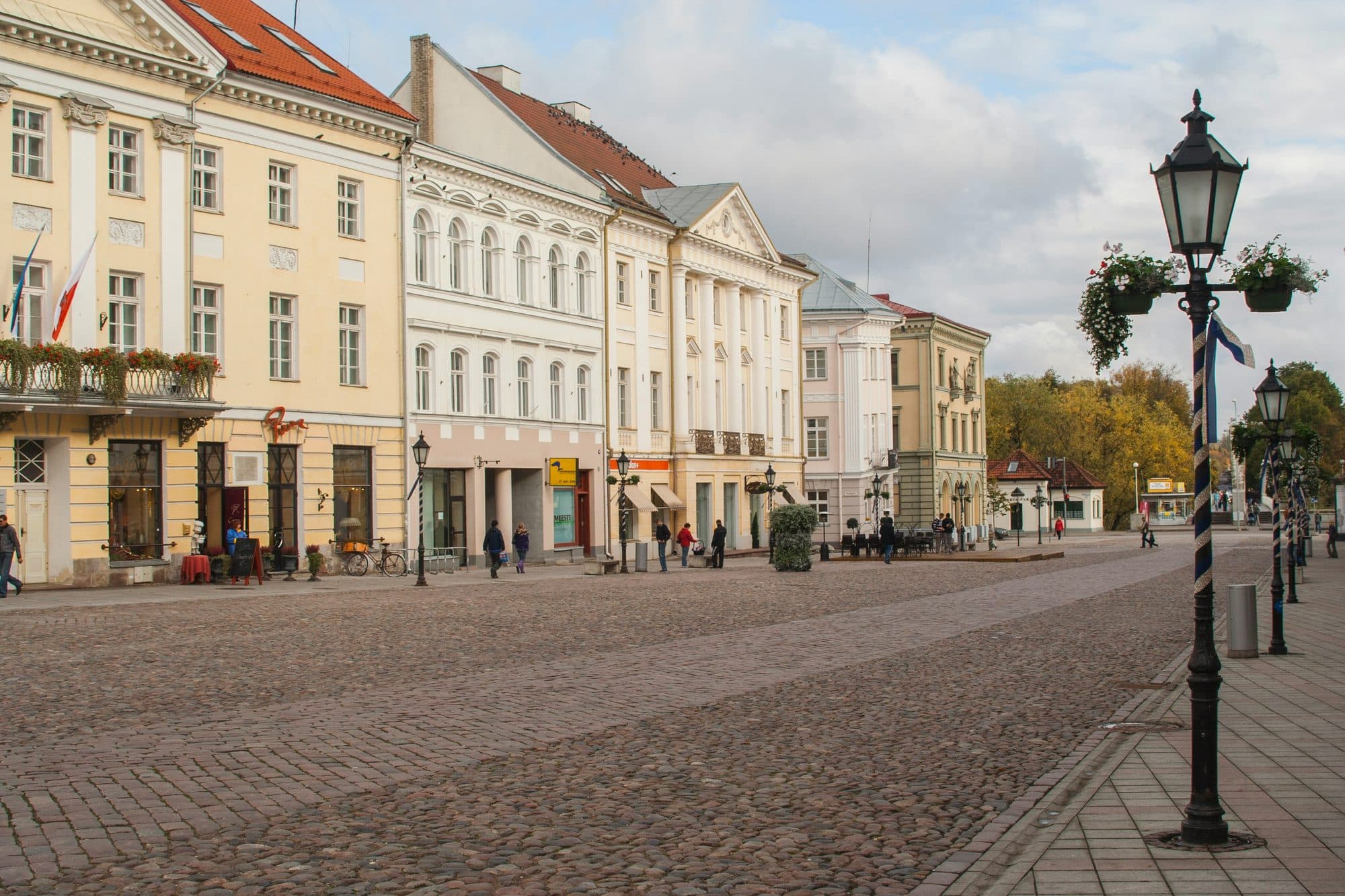
Tartu is also the clearest published example of Estonia's two-population-counts problem. The Population Register puts the city at 97,451; Statistics Estonia's residency-index method puts it roughly 3,229 higher, at about 100,700. The city government published both figures itself and named the gap. We use the Register throughout this site.
The city's own composition at 31 December 2025: Estonian 79%, Russian 10%, Ukrainian 5%, Finnish 1% — note that is ethnicity, not citizenship, and Tartu does not publish a foreign-citizen share.
Cost of Living
Tartu is meaningfully cheaper than Tallinn to buy in and cheaper to heat, and it has the country's cheapest district heating of the four cities.
| Tartu | vs Tallinn | |
|---|---|---|
| Apartments, secondary market | €2,400.00/m² | -19% |
| Typical two-room flat | €112,856 | -17% |
| District heating | €62.41/MWh | -20% — the cheapest of the four |
| Water and sewerage | €3.10/m³ | +8% |
| Median wage, county | €1,816 | -7% |
The trade is legible: housing about 19% cheaper, wages about 7% lower. Roughly a wash on the median, better if you are buying.
Neighbourhoods
Tartu publishes populations and areas for its 18 city districts, which lets you make the density argument from primary data rather than from atmosphere:
| District | Population | Area | Share of the city |
|---|---|---|---|
| Annelinn | 24,551 | 540 ha | 25.6% — a quarter of Tartu |
| Karlova | 8,444 | 230 ha | 8.9% |
| Tammelinn | 8,209 | 311 ha | 8.3% |
| Kesklinn | 6,465 | 180 ha | 7.1% |
| Supilinn | 2,125 | 48 ha | The smallest by area |
| Maarjamõisa | 448 | 113 ha | The hospital and science campus |
Populations are 2020; district shares are 1 January 2024. Annelinn holds a quarter of the city in 540 hectares; Supilinn holds 2,125 people in 48. That contrast is the whole neighbourhood story told in numbers the city itself publishes.
The usual characterisations — Supilinn and Karlova as the wooden-house bohemian districts, Tammelinn as leafy interwar family housing, Annelinn as the Soviet panel blocks, Maarjamõisa as hospitals and labs — are widely repeated, but none of it is asserted in any official document we could find. The area-and-population table above supports the density half of it from primary data; the rest is description, and we mark it as such.
Job Market
Tartu is the most average county in Estonia, and that is the point. Its GDP per capita is 98% of the national average — closer to the mean than any other county — on 12% of national GDP. Harju is at 134%, Pärnu at 67%. If you want a normal Estonian economy rather than the capital's, this is it.
The city names its own key sectors: biotechnology — it calls itself the centre of Estonia's medical and biotech landscape — ICT (Playtech, Nortal, Mooncascade, development centres for Bolt and Pipedrive, and an ESA business incubation centre), food (A. Le Coq, Salvest, Tartu Mill, exporting about a third of production), woodworking and metal processing. Invest in Estonia adds that services provide two-thirds of county employment.
Getting Around
City transport
Fares rose 1 June 2026:
- Residents: €1.20 an hour, €21.30 a month
- Everyone else: €1.80 and €31.90
- Bus plus bike share, residents: €30.00 a month
- Residents aged 65+ travel free
Registering your address is worth about €127.20 a year here.
Getting out
Thinner than Tallinn:
- Rail to Tallinn: ~10 a day, 2 h 38 min–3 h
- Rail to Narva: none direct — change at Tapa
- Tartu Airport, 10 km out: Helsinki only, Finnair, ~50 min
- That route was suspended 16 June–9 August 2026
- Elron also runs Tallinn–Tartu–Valga–Riga–Vilnius once a day, changing at Valga
Expat Life
The best newcomer service in Estonia is not the obvious one
Tartu Welcome Centre (Ülikooli 17) is a partnership of the city, the University of Tartu, the Estonian University of Life Sciences and the national association of municipalities. It is free, needs no appointment, and — this is the part that matters — it actually performs registrations: personal identification code applications, residence registration within Tartu, and personalising your bus card. Open Mon–Fri 09:00–16:00, Thursdays to 18:00.
Separately, International House Tartu (Lutsu 14a), established 2015 and funded by the Ministry of the Interior and the EU, covers advice and networking for the whole of Southern Estonia. The two are different organisations and neither page mentions the other, which catches people out. The Welcome Centre is the one that does paperwork.
Tartu also has the highest foreign-language proficiency of any Estonian city at 82% — marginally ahead of Tallinn. Between that and the university, English goes further here than the size of the place suggests.
Students: 15,573 at the University of Tartu at November 2025, of whom 1,435 (9.2%) are international, from 98 countries. About 3,000 more at the Estonian University of Life Sciences, roughly a tenth international. The city's yearbook counts 17,173 higher-education students overall.
Climate & Winters
Monthly mean temperature, Tartu-Tõravere station, 1991–2020 normals:
Tartu is inland, and it shows in both directions: warmer summer days than Tallinn (23.1 °C July mean maximum against 22.2 °C) and colder winter nights (−6.5 °C January mean minimum against −5.5 °C). It is also the driest of the four at 673 mm.
Tartu also gets the least sunshine in Estonia: 1,736 hours a year, against 1,923 in Tallinn and 1,950 in Pärnu. That is 214 hours a year less than Pärnu — the largest climate difference between any two Estonian cities that anyone publishes, and the one most likely to matter in February.
Practical Information
| Detail | |
|---|---|
| Personal ID code | The Welcome Centre can do this for you, which is unusual. See isikukood. |
| Register your address | Within 14 days; the Welcome Centre handles registrations within Tartu. Cuts your bus pass to €21.30. |
| Heating | €62.41/MWh excluding VAT — the cheapest of the four cities. |
| Language exams | Tartu is an exam city; the free Language Houses are in Tallinn and Narva only. See the language page. |
| Getting to Narva | No direct train. Change at Tapa, or drive. |
Frequently Asked Questions
Is Tartu much cheaper than Tallinn?
Meaningfully cheaper on housing, both to rent and to buy, and that gap is the main reason people choose it. Wages are lower too, so the net position depends on whether your income is local or remote.
Is Tartu a realistic place to work?
If you are in academia, research, biotech or software, yes — the university anchors an unusually deep local sector for a city this size. Outside those, the job market is thin.
Do people speak English in Tartu?
In and around the university, widely. It is a student city and a research city, which raises the baseline well above what the population would suggest.
Is it a good place to bring a family?
It is the case people most often make for Tartu: smaller, quieter, cheaper housing, and everything within cycling distance.
How does the winter compare with Tallinn?
Colder. Tartu is inland and does not get the sea's moderating effect, so the same season is a few degrees harder.
What is the difference between the Tartu Welcome Centre and International House Tartu?
They are two different organisations, neither page mentions the other, and that catches people out. The Tartu Welcome Centre (Ülikooli 17) is a partnership of the city, the University of Tartu, the Estonian University of Life Sciences and the national association of municipalities. It is free, needs no appointment, and it actually performs registrations: personal identification code applications, residence registration within Tartu, and personalising your bus card. Open Monday to Friday 09:00–16:00, Thursdays to 18:00. International House Tartu (Lutsu 14a), established 2015 and funded by the Ministry of the Interior and the EU, covers advice and networking for the whole of Southern Estonia. The Welcome Centre is the one that does paperwork.
Can I take free state Estonian courses in Tartu?
Not from the Integration Foundation. Its Estonian Language Houses are in Tallinn and Narva only, plus online — there is none in Tartu, which surprises people given the university. What Tartu is, is an exam city: Harno holds the state proficiency exam here quarterly and free of charge, at A2, B1, B2 and C1, and the civics exam for citizenship runs here monthly except July.
Can I fly out of Tartu, and how do I get to Narva?
Tartu Airport, 10 km out, has one scheduled route — Helsinki, with Finnair, about 50 minutes — and even that was suspended from 16 June to 9 August 2026. For anything else it is Tallinn. By rail there are about ten direct services a day to Tallinn, 2 h 38 min to 3 h, and no direct train to Narva at all: change at Tapa, or drive. Elron also runs Tallinn–Tartu–Valga–Riga–Vilnius once a day, changing at Valga.
How international is the University of Tartu, really?
Of 15,573 students at 10 November 2025, 1,435 — 9.2% — are international, from 98 countries. The Estonian University of Life Sciences adds about 3,000 more, roughly a tenth of them international, and the city's own yearbook counts 17,173 higher-education students in total. So the international community is real, and small in absolute terms, in a city of about 97,451.
Is everything cheaper in Tartu than in Tallinn?
No, and the exception is worth knowing before you sign a lease. District heating is the cheapest of the four cities at €62.41/MWh excluding VAT, against €77.82 in Tallinn. Water and sewerage go the other way: €3.10/m³ including VAT against Tallinn's €2.87, about 8% more. Housing is what dominates either way — the secondary-market square metre is 19% below Tallinn's.